
Key points
- Foreign policy has become an electoral issue. AUR, which contests the foundations of the 1995 Snagov consensus, leads the polls with close to 40%, and in March 2026 it refused to vote for a direct request from the Trump administration.
- The debate falls into three currents. Revolutionaries locate the problem in the Euro-Atlantic orientation itself. Continuists see no structural problem. Reformists locate it in the means: resources, political will and ideas.
- The US National Security Strategy of December 2025 made the question of hierarchy between the US and the EU unavoidable. Continuists answer with equidistance between Washington and Brussels. Reformists propose a hierarchy with Europe at the top. The only explicit Washington-first hierarchy now comes from the revolutionary camp.
- The way criticism is voiced matters. Substantive contestation erodes the consensus. Procedural contestation can strengthen it if it gets an answer, and when ignored for long it turns substantive too.
- Continuists control the institutions, revolutionaries have the electoral route, and reformists depend on persuasion. The 2026 government crisis and the Niculescu government, with a prime minister and a foreign minister drawn from the diplomatic service, have kept this balance in place.
Why a map
For a long time, foreign policy was a niche subject in Romania, left to diplomats and a handful of experts and rarely raised in election campaigns. The Snagov consensus, sealed in June 1995 and reaffirmed in 2001, gave every parliamentary party the same strategic destination. What we now call the “strategic trinity”, namely NATO membership, integration into the European Union and the strategic partnership with the United States, thus became common ground that nobody felt the need to defend, because nobody contested it.
The 2024–2025 electoral cycle ended this calm. Călin Georgescu won the annulled first round of November 2024 with 22.9% of the vote, and in May 2025 George Simion took almost 41% in the first round, both campaigning against the country’s foreign policy orientation. A year later, AUR polls close to 40%, more than PSD and PNL combined, and the pro-European coalition formed in June 2025 fell on 5 May 2026 to a no-confidence motion tabled jointly by PSD and AUR. Almost six months of crisis followed, ending only on 20 October with the investiture of a minority government led by Luca Niculescu.
Foreign policy has thus become a stake in political competition, and the debate about it is livelier than ever. It is also a debate that often looks chaotic, full of accusations of treason, sovereigntist nostalgia and laments about Romania’s absence from the tables where decisions are made. Beneath the noise, however, a few well-defined orientations can be discerned, each with its own logic and with predictable fault lines. In this policy brief I map them with three readers in mind: decision-makers in Bucharest, who need to tell apart those who want to change the country’s direction from those who want the direction followed better; Romania’s international partners, who are trying to understand what lies behind the polarisation; and a public that needs a shared vocabulary for a debate that concerns it directly.
Three currents
Three strands of thought run through the positions, criticisms and laments in Romanian public debate. They differ in the diagnosis they give Romanian foreign policy, in the causes they find and in the treatment they propose.
The revolutionaries
The strand that shakes the foundations of post-1989 foreign policy hardest is the revolutionary one, promoted mainly by the radical right. For its adherents, Romania’s problem is its strategic alignment itself. Anchoring the country in the West has supposedly blocked “balanced” relations with other great powers, and EU and NATO membership has turned Romania into a state subordinated to decisions taken in Brussels and Washington, with an economy dominated by foreign capital and a foreign policy voice reduced to an echo of others’ interests.
The prescription follows naturally from the diagnosis: a strategic rupture and a multivector, non-aligned foreign policy in which Romania cultivates pragmatic relations with all great powers, Russia and China included. We can call this vision neo-Ceaușist, because it dresses up an old tradition of Romanian autonomism in new clothes. Călin Georgescu summed it up in May 2025: “You have to get along with everyone: impeccably with your neighbours, very well with the great powers.” The AUR programme formally keeps the Euro-Atlantic option while introducing the idea of a multivector foreign policy, and its most elaborate formulation, that of the party’s first vice-president, Dan Dungaciu, starts from the premise that the European Union cannot be “a viable security actor” and calls for a diplomacy that talks “to everyone.”
The current is not monolithic. Some of its adherents dream of equidistance between the great powers, others of a privileged bilateral relationship with Washington at the Union’s expense, others of an Orbán-style policy in which EU membership becomes a lever for obstruction and for bargaining with every camp. What unites them is the conviction that the Euro-Atlantic orientation is the source of Romania’s problems.
The continuists
At the opposite pole, the state institutions that run foreign policy remain dominated by the continuist strand. Its representatives reject almost any criticism of the performance of Romanian diplomacy. Romania met its major objectives with NATO accession in 2004, EU accession in 2007 and Schengen membership in 2025, and what remains is to consolidate these gains through coherence and predictability. Any departure from this course looks like a risky adventure, and the expectation of a more assertive foreign policy is deemed unrealistic for a country of Romania’s size and resources. Success, in this view, comes from the reputation of a loyal and predictable partner.
“Continuity” and “predictability” are the words that recur constantly in official discourse, from Klaus Iohannis’s presidency to that of Nicușor Dan, who has kept the broad lines of his predecessor’s approach. To revolutionaries, continuists reply that the cure risks killing the patient; to reformists, that Romania already does all that is realistically possible.
To the question of hierarchy between the US and the EU, which became pressing after December 2025, continuists answer with equidistance. The National Defence Strategy for 2025–2030, adopted by Parliament by 314 votes to 43, lists the partnership with the US and European integration among the pillars of national security without ranking them, and proposes the formula of “solidary independence”: Romania pursues its own interests in full solidarity with all its allies. In public debate, the same logic appears as a “pendulum” between the alliance with Washington, the capacity to act independently and the unity of the Union. Washington and Brussels thus remain equal pillars, and choices between them are made case by case.
The reformists
Between the two poles lies the reformist strand. It starts from a diagnosis close to the revolutionary one: Romanian foreign policy performs well below its potential, and Romania’s voice rarely counts where decisions are made. The causes it identifies, however, are domestic. The strategic orientation remains right, and the problems lie in the means and the mindset with which it is pursued. Once the great integration goals were met, the elites put foreign policy on “autopilot,” and Romania became a “diligent pupil” that falls in line with others’ decisions and rarely proposes anything.
In the reformist reading, three factors explain this stagnation: chronic underfunding of diplomacy, a lack of political will for an ambitious foreign policy, and the persistence of ideas formed during the transition years, which stifle strategic imagination. The treatment is less invasive than the revolutionary one, but it takes courage: more resources, new ideas and positions that are owned. The boat is heading the right way; the pace and strength of the rowing have to change. The current’s voices come mostly from the expert community and the diplomatic service, and in recent years their language has reached the executive too, from the 2025 promises to reform the foreign ministry to Prime Minister Luca Niculescu’s call, in October 2026, for a move “from the diplomacy of participation to the diplomacy of projects.”
On the question of hierarchy, reformists go further than continuists and propose an explicit order, with Europe at the top. If the US strategy of December 2025 signals a lasting American retrenchment, European defence integration becomes a national security priority, and the relationship with Washington remains important without being the only safety net. An explicit hierarchy is, moreover, a condition for reform: without it, diplomacy’s limited resources cannot be allocated coherently.
The question that divides
Until recently, the three currents differed mainly in how much they wanted to change. The US National Security Strategy, published in early December 2025, added a second fault line. The document describes Europe as a weak actor facing “civilizational erasure,” and a longer version, never officially released and reported by Defense One, named four European states Washington should work with to pull them away from the EU. Romania was not among them. Since then, the question “whom do we rely on first?” has run through every camp, and the answers to it define the variants within each current.
| Current | Variant | Logic |
|---|---|---|
| Revolution | Multivectorialism | “Very good” relations with all great powers; distance from the EU and NATO |
| Bilateralism with Washington | The US as the only credible guarantor; the EU not viable as a security actor | |
| The Orbán model | EU membership as a lever for obstruction and for balancing between blocs | |
| Continuity | Transatlantic equidistance | The US and the EU as equal pillars; case-by-case decisions without an explicit hierarchy |
| Reform | Europe at the top of the hierarchy | European defence integration as a national security priority; the US relationship remains important |
| Reform of instruments | Resources, a professional foreign ministry, its own analytical capacity |
The table reveals a paradox. The old hierarchy of Romanian Atlanticism, with Washington first, today finds its most explicit defenders in the revolutionary camp, where a preference for the United States goes hand in hand with suspicion of the European Union. Continuists refuse to rank the pillars, and reformists rank them the other way round, keeping both.
Orientation and change
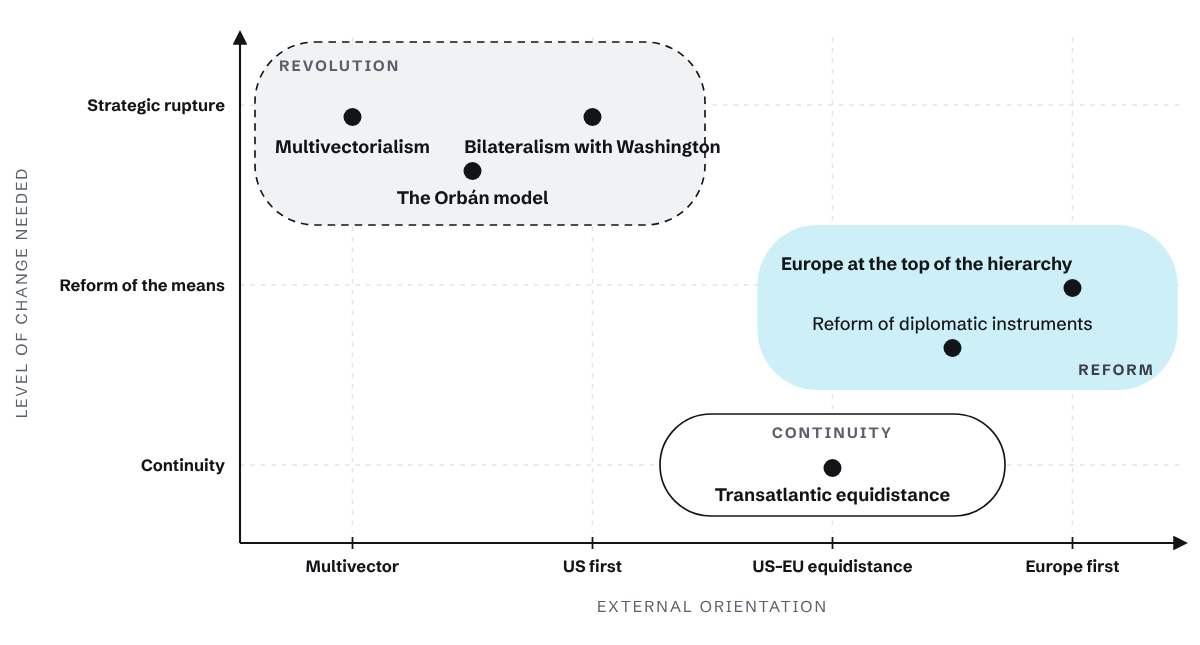
The currents and their variants can be placed on a map with two dimensions. The first is external orientation, which runs from multivectorialism, which gives up the Western anchor, through a preference for Washington and equidistance between the US and the EU, to a hierarchy with Europe at the top. The second is the level of change considered necessary: continuity, reform of the means, or strategic rupture.

The map explains why the debate looks confused. Two positions can be close on one dimension and far apart on the other. Reformists and revolutionaries share the diagnosis of underperformance and part ways on both its causes and the orientation. Continuists and reformists share the Euro-Atlantic orientation and part ways on hierarchy and on the change needed.
The map also shows a shift over time. Until 2024, the main dispute concerned the level of change: rupture or continuity. After December 2025, the dispute over orientation, that is, over the hierarchy between the US and Europe, became just as important. This is an old pattern in Romanian strategic thought. Systemic shocks reopen the debate about the country’s fundamental orientation, and sub-schools emerge within the dominant camp, as the Germanophiles and the supporters of the Entente did during the years of neutrality, between 1914 and 1916. Today these sub-schools are the Atlanticists and the Europeanists.
One corner of the map remains empty. No relevant political force calls for a strategic rupture in Europe’s favour, and those who put Europe at the top of the hierarchy propose a reordering within the Euro-Atlantic framework.
Modes of contesting foreign policy
To understand the debate, knowing who contests and what they contest is not enough. How they do it matters just as much, because different modes of contestation have different effects on the Snagov consensus. A simple distinction helps here. Substantive contestation targets the substance: the pillars of the strategic orientation, namely European integration, NATO membership and the partnership with the US. It proposes a reorientation, either towards multivectorialism or towards forms of “diversification” that imply distance from Euro-Atlantic structures. Procedural contestation accepts the substance and criticises the form: the quality of diplomacy, the effectiveness of its instruments, the performance with which strategic relationships are managed.
The March 2026 decision on Romanian air bases brought out both modes. On 11 March, the Supreme Council of National Defence approved a US request to deploy refuelling aircraft and communications equipment to Romania temporarily for operations against Iran, and Parliament endorsed the decision the same day by 272 votes to 18, with 5 abstentions. AUR, SOS and POT lawmakers disrupted the debate and refused to vote, and the AUR leader asked the US ambassador to be “an ally of Romanians, not a master.” The irony is plain. A party that had presented itself for years as Donald Trump’s natural ally opposed a direct request from the Trump administration. What it contested was the pro-Western orientation and the government that upholds it, and its attitude to Trump proved selective once again.
At the same time, liberal-progressive voices and members of the expert community contested the same decision procedurally. If we are strategic partners, why does the relationship run one way? Why do we offer bases when Romania was removed from the Visa Waiver Program in 2025 and the United States reduced its military presence on Romanian soil in October of the same year? This criticism leaves membership of the alliance untouched and asks for the relationship to be managed better.
The distinction does not separate the camps perfectly. The radical right favours substantive contestation but also uses procedural criticism, about underfunded diplomacy or Romania’s invisibility, to delegitimise the orientation itself. Liberal-progressives favour procedural contestation but move into substantive contestation when they question the hierarchy between the US and the EU and ask for priority to European strategic autonomy.
The effects of the two modes are nonetheless opposite. Substantive contestation erodes the consensus even when it wins no majorities. Multivectorialism and neutrality were marginal positions before 2020; today they are discussed openly, and the window of options considered legitimate has widened. Procedural contestation, by contrast, can strengthen the consensus, because it asks elites to deliver better on what they have already promised. That depends on the response it gets. If reforms are postponed indefinitely and reciprocity with partners remains a private aspiration, procedural criticism gradually turns into substantive criticism. The establishment’s dominant reflex so far has been to treat any criticism as a threat to the country’s orientation, confusing reformists with revolutionaries. Such a reflex pushes procedural critics exactly where they do not want to go.
Who holds the levers
The competition between the three currents plays out on two fronts: control of the institutions, and the test of performance under external shocks. On the first front, continuists have an overwhelming advantage. They are the “operating system” of the Ministry of Foreign Affairs, the Presidential Administration and the other institutions with external responsibilities, and for most diplomats continuity is the culture of the institution in which they were formed. The 2026 crisis did not change this balance: the new prime minister and the new foreign minister both come from the diplomatic service, and parliamentary majorities remain Euro-Atlantic, as the votes on the defence strategy and on the March decision showed.
Revolutionaries have no conventional way into this fortress. Their only route is an electoral victory that would let them appoint the president, the prime minister and the foreign minister and restructure the diplomatic service. With AUR at around 40% in the polls and parliamentary elections due in 2028, that scenario is no longer hypothetical, and the joint PSD–AUR motion of May 2026 showed that a majority including AUR can be built.
Reformists are in the hardest position. They are a kind of “loyal opposition,” inside the system or close to it, without decision-making power, and they can win only through persuasion, by convincing the continuist fortress that changing the means has become necessary. They do have the advantage of the diagnosis. The external shocks of 2025–2026 exposed the limits of reactive diplomacy, and a foreign policy on autopilot erodes its own legitimacy over time.
The currents at a glance
| Revolution | Reform | Continuity | |
|---|---|---|---|
| Strategic orientation | Multivector | Euro-Atlantic, with own initiative | Euro-Atlantic, stable anchor |
| Source of the problem | External alignment (the strategic trinity) | The means: resources, political will, ideas | No structural problem |
| Intensity of change | Strategic rupture | Reform of the means | Gradualism |
| US–EU hierarchy | Washington, bilaterally, or multivectorialism | Europe at the top, the US an important partner | Equidistance, no explicit hierarchy |
| Openness to Russia and China | High, “pragmatic” | Minimal, cautious | Minimal, cautious |
| Policy style | Proactive, disruptive | Proactive, constructive | Reactive, cautious |
| Preferred formats | Opportunistic bilateralism | Proactive multilateralism | Conformist multilateralism |
| Foreign ministry resources | Criticises underfunding, no commitments | More resources | Current level, minor adjustments |
| Dominant mode of contestation | Substantive | Procedural | Defends the status quo |
| Acceptable risk | High | Moderate | Low |
What to watch in the coming months
The map will change. The indicators below show in which direction.
- The foreign ministry budget for 2027. The draft budget, due for adoption by the end of the year, will show whether the Niculescu government treats diplomacy as a priority or leaves it in the same precarious state.
- The US force posture review in Europe. Launched at the end of July 2026 for up to six months, it will show what remains of the US presence in Romania and how Bucharest responds.
- Parliamentary votes on foreign and defence matters. What matters is how AUR, SOS and POT vote, and also the governing parties, especially PSD, which has said it will reassess its support for the government after six months.
- Official language on the US–EU hierarchy. Watch whether the president, the government and the foreign ministry set out an explicit order of priorities or stay with equidistance.
- SAFE implementation. The €16.68 billion from the EU defence instrument, the second-largest allocation after Poland’s, will show how closely Romania ties itself to European defence integration.
- Institutional openness to procedural criticism. Genuine consultations, parliamentary hearings and cooperation with academia and think tanks would signal that the establishment can tell reformists from revolutionaries.
- AUR’s foreign policy programme and people. It remains to be seen whether the party moves towards the Meloni model of normalisation in government or the Orbán model of obstruction and balancing between blocs.
Conclusions
Victory in this competition of ideas is not predetermined. In the short term, continuists keep the institutions, and Romania’s Euro-Atlantic orientation is not up for negotiation in the current parliamentary arithmetic. The window of options considered debatable has widened, though, and will stay wider whatever the outcome of the 2028 elections.
In the long term, the winning current will be the one that convinces people it has the answer to the real problems of Romanian foreign policy. The decisive contest today is between the comfortable inertia of the continuists and the need for adaptation championed by the reformists. If reformists manage to transform the institutions from within, Romania’s external orientation can be renewed without rupture. If frustration with stagnation builds up faster, it will open the way for the revolutionaries.
For Romania’s partners, the map has a practical implication. Polarisation has so far left the country’s foreign policy unchanged and has changed the conditions in which that policy is made. Partners who want an active and predictable Bucharest can help by answering the procedural criticism: visible reciprocity in bilateral relations, and a seat for Romania in the formats where decisions are taken.
References
- Adevărul (2026). “Dan Dungaciu, la Interviurile Adevărul: AUR vrea la putere, nu la guvernare”, 2 February 2026. adevarul.ro
- Al Jazeera (2026). “Romania PM Ilie Bolojan’s government toppled in no-confidence vote”, 5 May 2026. aljazeera.com
- Defense One (2025). Excerpts from the longer version of the US National Security Strategy, 9 December 2025, as reported by Notes from Poland, 10 December 2025.
- Financiarul (2026). “Dan Neculăescu anunță prioritate pentru Marea Neagră la preluarea mandatului”, 21 October 2026. financiarul.ro
- G4Media (2025). “Călin Georgescu vrea relații cu Rusia, China și Brazilia”, 16 May 2025. g4media.ro
- Ghincea, M. (2025a). “Georgescu Doctrine vs. the Snagov Consensus: Pro-Atlantism or Neo-Ceaușism for Romanian Foreign Policy?” Contributors.ro, 2 March 2025.
- Ghincea, M. (2025b). “Politica externă românească este prinsă între nevoia schimbării și imperativul continuității”. Contributors.ro, 31 July 2025.
- Ghincea, M. (2025c). “Revoluție, reformă sau continuitate? O cartografiere a dezbaterii privind politica externă românească”. Contributors.ro, 24 August 2025.
- Ghincea, M. (2025d). “România fără America? Pentru un europenism strategic românesc”. Contributors.ro, 15 December 2025.
- Ghincea, M. (2026a). “Meloni or Orbán? What would the foreign policy of an AUR government look like?” Bucharest: Friedrich-Ebert-Stiftung Romania, 26 January 2026.
- Ghincea, M. (2026b). “Iranul, SUA și consensul de politică externă de la București”. Contributors.ro, 23 March 2026.
- INSCOP Research (2026). Barometrul INSCOP Research: intenția de vot, fieldwork 1–7 September 2026.
- Observator News (2026). “Circ în Parlament la votarea propunerii CSAT despre forțele pe care SUA le vor aduce în România”, 11 March 2026. observatornews.ro
- Romanian Parliament (2025). Decision approving the National Defence Strategy for 2025–2030, 26 November 2025.
- Reuters (2026). “Romanian parliament confirms new prime minister after months of deadlock”, 20 October 2026.
- The White House (2025). National Security Strategy of the United States of America. Washington, DC, December 2025.
This policy brief draws on and updates arguments the author published on Contributors.ro between March 2025 and July 2026. Quotations from Romanian sources are the author’s translations. The views expressed are those of the author and do not necessarily represent the position of the Quartet Institute.