
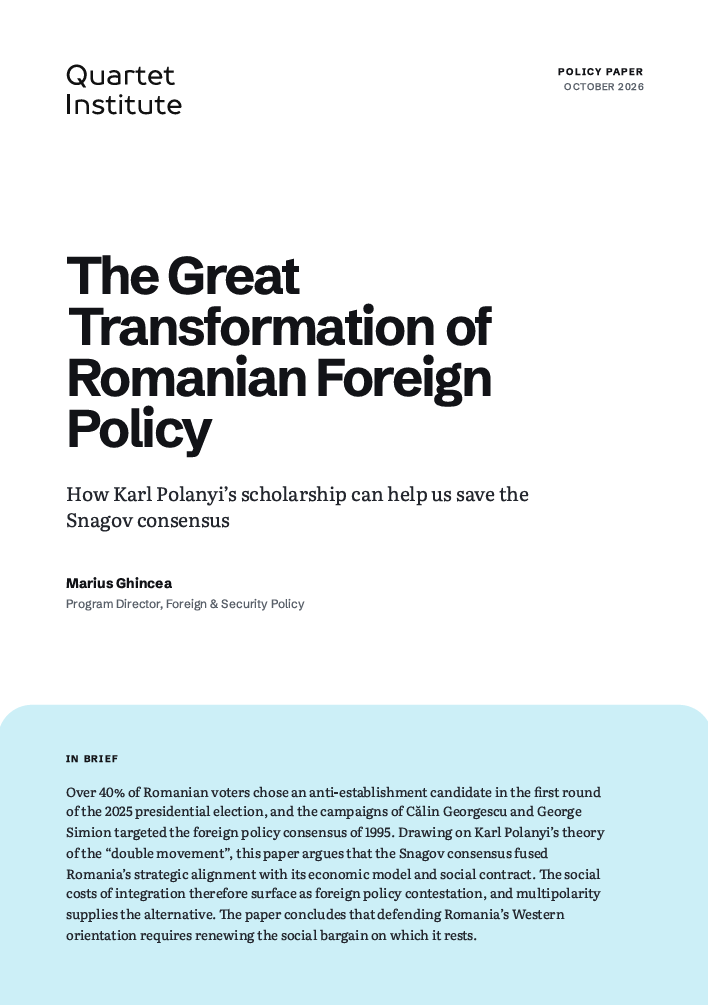
Key points
- The sovereigntist vote of 2024–2025 has socio-economic roots. Its foreign policy form, a call for multivectorialism and strategic neutrality, requires a separate explanation.
- The Snagov consensus of 1995 bundled a strategic orientation (NATO, the EU, the US), an economic model (liberalisation, privatisation, FDI-led growth, open labour markets) and a social contract (shared prosperity). Contesting the economic model therefore means contesting the alignment.
- Integration delivered real gains, with GDP per capita rising from about 41% of the EU average in 2007 to around 77% in 2024, and heavy, unevenly distributed costs: depopulation, the emigration of millions, deindustrialisation and a widening urban-rural divide.
- Multipolarity gives the counter-movement a foreign policy programme. Interwar Romania followed the same pattern when an alternative pole emerged in the 1930s.
- Securitisation and democratic resilience address the permissive conditions and the transmission mechanism. A durable defence of the consensus requires renewing its social contract and giving the communities that bore the costs of integration a material stake in it.
Introduction: the form of the sovereigntist vote
In the presidential elections of 2024 and 2025, millions of Romanians voted for candidates who rejected the foundations of the country’s foreign policy. Călin Georgescu won the annulled first round of November 2024 with 22.9% of the vote. George Simion won the repeat first round in May 2025 with nearly 41%. Neither campaigned primarily on economic redistribution. Both campaigned against the foreign policy orientation that has defined Romania since 1995, and since then the Romanian political debate has become structurally divided between “pro-Europeans” (or “pro-Westerners”, President Nicușor Dan’s preferred term) and “pro-Russians”.
A new book by Alina Pop, Filip Alexandrescu and Ionuț-Marian Anghel, Suveranismul în România (Humanitas, 2026), asks why so many Romanians chose a radical political option. Its answer, familiar to specialists and at odds with the simplified narratives common in Romanian public debate, is socio-economic: unequal development, the dismantling of the social state, the absence of opportunity, and the widening gap between the relative winners and losers of transition. The authors’ quasi-ethnographic work in three communes that voted heavily for the radical right gives access to the inner world of the Romanian precariat, its fears, frustrations and sense of abandonment, which fuel the demand for radical change. The book confirms that the roots of the radical right vote are socio-economic, and that durable solutions must also be socio-economic.
The book explains the demand side: why so many Romanians wanted radical change. It leaves open a second question. Why did this demand take the form of a call for a multivectorial foreign policy, strategic neutrality and a fundamental reorientation of Romania’s place in the world, when it could have taken the form of a call for a stronger welfare state or a more redistributive economic policy? This paper offers a theoretical framework that answers this question, drawn from the work of the political economist Karl Polanyi, and derives policy implications for the defence of Romania’s pro-Western consensus.
The Snagov consensus as a political economy bargain
The orientation contested in 2024 and 2025 has a name: the Snagov consensus. On 21 June 1995, the leaders of all parliamentary parties signed a declaration at a villa on the shore of Lake Snagov that committed Romania’s political class to European integration as the country’s strategic destiny. The commitment was reaffirmed in 2001 with a specific commitment to NATO membership. For nearly three decades the consensus broadly held. It survived alternations in government between left and right, economic crises, the slow grind of accession negotiations, the disappointments of post-accession politics and the constant struggles between the clientelist networks that dominate Romanian politics. Nicușor Dan won the presidency in May 2025 on a pro-European platform, yet the structural fact remains that over 40% of Romanian voters chose a candidate running against this consensus.
Writing in 1944, Polanyi argued that the expansion of market society produces a predictable counter-movement. When economies are “disembedded” from social relations, and labour, land and money are treated as commodities allocated by market forces, the social costs accumulate until society mobilises to protect itself. Polanyi called this the “double movement”: a first movement of market liberalisation, followed by a second movement of social self-protection. The counter-movement is driven by the structural dislocation that liberalisation produces. Ideology, which cultural explanations of populism place at the centre, arrives later, as a vehicle.
The central claim of this paper is that the Snagov consensus was a political economy commitment that Romanian elites made under the heading of foreign and security policy. The report of the “Snagov Committee” that preceded the declaration makes this visible: the committee was tasked solely with developing a new economic development strategy for the country. “Joining the West” bundled together three elements:
- A strategic orientation: NATO, the European Union and the United States.
- An economic model: market liberalisation, privatisation, growth driven by foreign direct investment, and open labour markets.
- A social contract: the promise that integration would deliver broadly shared prosperity.
This bundle is what we now call the Snagov consensus. Because its elements were inseparable, contesting the economic model eventually meant contesting the foreign policy that enabled it.
The gains and costs of the first movement
The first movement, Romania’s disembedding into the Western liberal order, delivered real gains. GDP per capita in purchasing power standards rose from about 41% of the EU average at accession in 2007 to around 77% in 2024, making Romania one of Europe’s fastest-growing economies. Bucharest, Cluj, Timișoara and Iași became dynamic urban centres integrated into the European single market.
The first movement also generated severe social costs. The most dramatic is emigration. Between the 1992 and 2021 censuses, Romania lost about 17% of its population. More than four million Romanians, roughly one in five, left to live and work in Western Europe. In 2024, 3.1 million Romanian citizens lived in other EU member states, the largest such group in the Union. Entire regions aged rapidly, towns lost their working-age populations, and Romania developed one of the fastest rates of depopulation in the EU. Accession in 2007 accelerated the trend by removing the remaining barriers to labour mobility.
This is Polanyi’s commodification of labour in its purest form. Romanian workers became inputs in Western European labour markets: construction workers in Germany, care workers in Italy, agricultural labourers in Spain. The Romanian economy received remittances that sustained the families who stayed and supported a shallow domestic demand. Western European economies received cheap, skilled labour. The human cost was borne by the communities left behind, and above all by children left in the care of relatives.
Beyond emigration, Romania experienced the deindustrialisation of uncompetitive sectors, a widening gap between urban and rural areas, and the concentration of the gains from integration among the educated, mobile and urban. These developments fed a pervasive perception, with a real basis, that the political class had captured the management of European integration for its own benefit.
Why the counter-movement targets foreign policy
In most Western European countries, the distributional grievances generated by economic integration can be separated from foreign policy. A French voter can oppose austerity and support NATO membership. A Greek voter can contest the terms of the eurozone bailout and still reject a strategic reorientation towards Russia. In these countries the economic model and the foreign policy alignment are distinct commitments, open to separate contestation.
In Romania they are fused. The Snagov consensus bundled them together: EU accession was at once the economic model and the foreign policy. Contesting the distributional consequences of integration therefore means contesting, in some form, the integration project itself. This explains why the Romanian counter-movement takes a strongly foreign-policy form, while counter-movements in Germany or France remain largely domestic. Georgescu demands a new alignment, a multivectorial foreign policy, because in Romania the economic model and the strategic orientation are the same project.
Multipolarity supplies the content of this demand. In a unipolar world the counter-movement had no foreign policy programme to offer, because there was no other pole to turn to. The autochthonist current in Romanian politics that Georgescu embodies, a tradition of resistance to external integration running from Eminescu to Ceaușescu, could offer cultural grievance and nothing more. The return of great power competition changes this. Once China, Russia and other poles appear as credible sources of alternative benefits and opportunities, multivectorialism becomes articulable as a policy programme that also claims to answer problems of social dislocation and economic development. The international system provides the menu of options that makes the foreign policy demand of Georgescu’s and Simion’s counter-movement coherent, even though, in Romania’s case, these options are largely illusory.
A historical precedent: the interwar liberal consensus
Romania has been here before. In the 1920s an elite-driven liberal consensus anchored the country in the French alliance system, the Little Entente and the League of Nations. That consensus also bundled strategic alignment with a liberal economic model, and it also eroded as the social costs of that model accumulated and an alternative pole appeared. The indifference of France and Britain to Romania’s economic plight during the Great Depression undermined domestic faith in the Western guarantors, while Nazi Germany’s growing economic weight in Southeastern Europe offered an alternative. As Rebecca Haynes has documented, Romanian politicians actively pursued rapprochement with Berlin, going well beyond submission to German pressure. The counter-movement found its pole.
The structural parallel with the present is instructive:
| 1920s–1930s | 2010s–2020s | |
|---|---|---|
| Elite consensus | French alliance, Little Entente, League of Nations, liberal economic model | Snagov consensus: EU, NATO, US, market liberalisation |
| Accumulated social costs | Social costs of the liberal model, deepened by the Great Depression | Emigration, depopulation, deindustrialisation, regional inequality |
| Alternative pole | Nazi Germany’s economic weight in Southeastern Europe | Russia, China and other poles in a multipolar order |
| Outcome | Rapprochement with Berlin | Foreign policy contestation by Georgescu, Simion and the sovereigntist parties |
In both periods an elite consensus bundled foreign policy with political economy, the social costs of the economic model accumulated over time, and the consensus held for as long as the international system offered no alternative pole. In both periods the appearance of a credible, or seemingly credible, alternative gave the counter-movement a foreign policy programme and turned it into an object of domestic partisan contestation.
Why current responses fall short
If this analysis is correct, the standard prescriptions for defending the pro-Western consensus treat the symptoms and leave the causes in place. The Polanyian framework distinguishes three conditions, each addressed unevenly by current policy:
| Condition | What it is | Current response |
|---|---|---|
| Permissive | Multipolarity, which offers alternative poles | Securitisation of the Russian threat |
| Transmission | External actors exploiting domestic grievances | Democratic resilience: counter-disinformation, media literacy, electoral integrity |
| Productive | Distributional dislocation caused by the integration model | Largely unaddressed |
Securitisation of the external threat argues that Romania faces Russian aggression and therefore must maintain its Western alignment. It addresses the permissive condition and leaves the productive condition untouched. It asks the populations who bore the costs of integration into the single and world markets to accept those costs indefinitely because the geopolitical environment is dangerous. This may work in the short term, and Nicușor Dan’s election suggests it did. It does not resolve the underlying structural tension that Pop, Alexandrescu and Anghel document.
Democratic resilience programmes, meaning counter-disinformation, media literacy and electoral integrity measures, address the transmission mechanism through which external actors exploit domestic grievances. The grievances themselves remain. The approach resembles treating a fever by covering the patient with a blanket, without diagnosing the infection.
Recommendations
A Polanyian diagnosis points to a different prescription. If the counter-movement is generated by the social costs of the integration model Romania has pursued for three decades, the only durable way to defend the consensus is to renegotiate the social contract on which it rests.
- Treat the distributional failure of integration as a strategic vulnerability. The erosion of the Snagov consensus is a security problem with economic causes. Decision-makers responsible for Romania’s foreign and security policy should treat regional inequality, depopulation and the uneven gains of integration as threats to the country’s Western alignment.
- Renew the cross-class bargain behind the Snagov consensus. The consensus held for as long as it promised that European integration and the country’s pro-Western orientation would benefit everyone. Its renewal requires spreading the gains of integration more broadly across regions and social groups.
- Give the communities that bore the costs a material stake in the Western alignment. Communities that lost their populations to emigration, their industries to competition and their young people to Western European labour markets need tangible benefits from Romania’s continued integration.
- Pair securitisation and democratic resilience with a distributional agenda. Deterrence of Russian aggression and protection of the information space remain necessary. On their own they address the permissive conditions and the transmission mechanism, and leave the grievances that sustain the counter-movement in place.
- Use the time bought by the 2025 election. The pro-European victory of May 2025 gives policymakers a limited window to address the structural causes of the sovereigntist vote before the next electoral cycle.
Conclusions
The Snagov consensus was a cross-class bargain. It held for so long because it promised that European integration and the country’s pro-Western orientation would benefit everyone. The post-accession reality concentrated the benefits in the hands of a few, and the social base of the bargain eroded as the asymmetrical costs and social dislocation became impossible to ignore. Either the bargain is renewed on terms that address its distributional failure, or the counter-movement will keep finding its audience, regardless of who occupies the Cotroceni Palace and of what Russia or other malign actors do.
Nicușor Dan’s victory buys time. A solution still has to be built. The 41% who voted for George Simion in the first round of May 2025 remain the counter-movement’s social base, and they have structural reasons to be there. The first year of the new presidency has offered little evidence that policy is moving in the direction this diagnosis requires.
References
- Eurostat (2025). GDP per capita in purchasing power standards, EU = 100. Luxembourg: Eurostat.
- Eurostat (2025). EU citizens living in another Member State: statistics on mobile citizens. Luxembourg: Eurostat.
- Haynes, R. (2000). Romanian Policy towards Germany, 1936–40. Basingstoke: Macmillan.
- Institutul Național de Statistică (2023). Recensământul Populației și Locuințelor 2021. Bucharest: INS.
- Polanyi, K. (1944). The Great Transformation: The Political and Economic Origins of Our Time. New York: Farrar & Rinehart.
- Pop, A., Alexandrescu, F. and Anghel, I.-M. (2026). Suveranismul în România. De ce votează oamenii cu politicienii extremiști? Bucharest: Humanitas.
An earlier version of this text was published on Priors & Posteriors, 6 June 2026. The views expressed are those of the author and do not necessarily represent the position of the Quartet Institute.